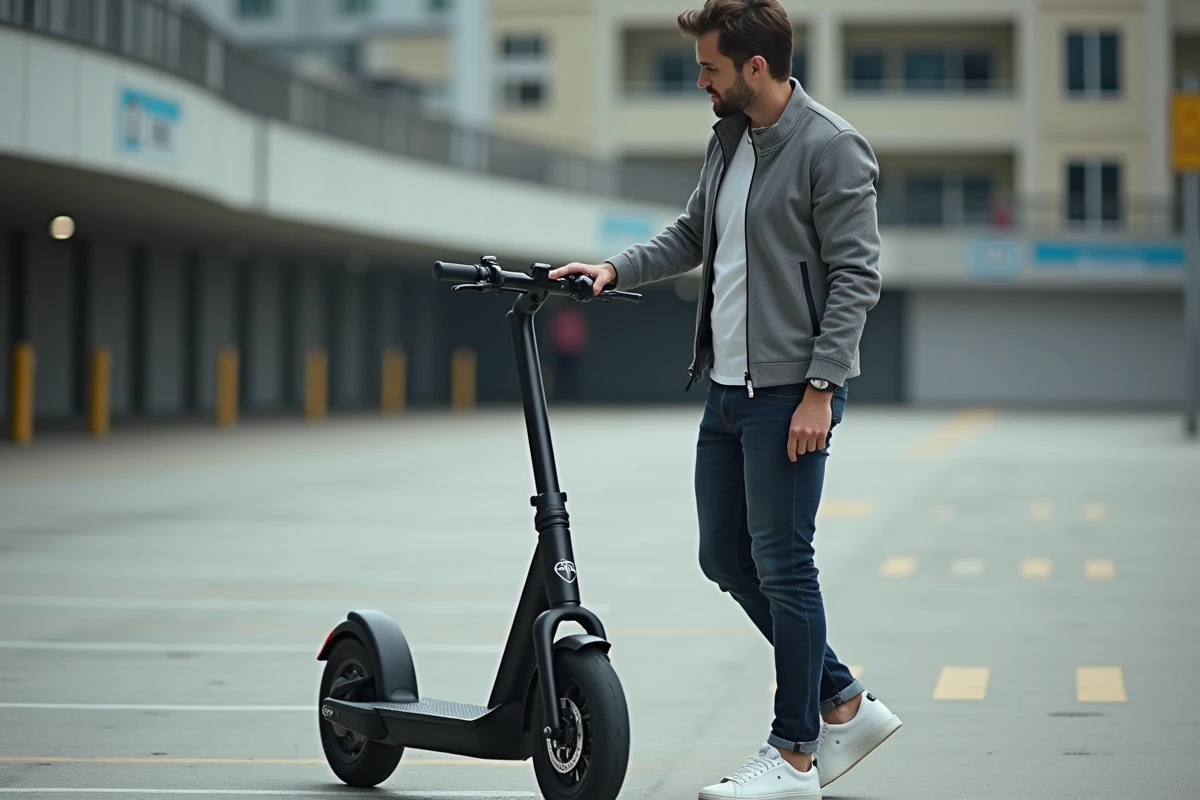
An adult scooter is primarily defined by its dimensions: length, width, seat height, and wheel diameter. These four measurements determine riding comfort, cornering stability, and the ability to place feet on the ground when stopped. Before comparing engine types or brands, knowing the standard dimensional ranges allows for a quick elimination of models unsuitable for one’s physique.
Seat height and wheel diameter: the two dimensions that determine an adult’s comfort
On a scooter, the seat height sets the position of the pelvis and the ability to touch the ground. For adults, recent models typically feature a seat height close to 700 to 800 mm. A 50 cc scooter designed for adult use, like the Eccho Talia 50 cc, offers a seat height of around 770 mm with 12-inch wheels.
The wheel diameter plays a direct role in road handling. 12-inch wheels absorb road irregularities better than 10-inch wheels, which are common on compact models aimed at a younger audience. For an adult weighing over 65 kg, this stability gain is felt from the first kilometers in urban areas.
The combination of a high seat and large wheels slightly extends the wheelbase, which reduces steering responsiveness. To know in detail the standard dimensions of a scooter according to each engine category, one must cross-reference the manufacturer’s technical sheet with their own height, particularly the inseam.
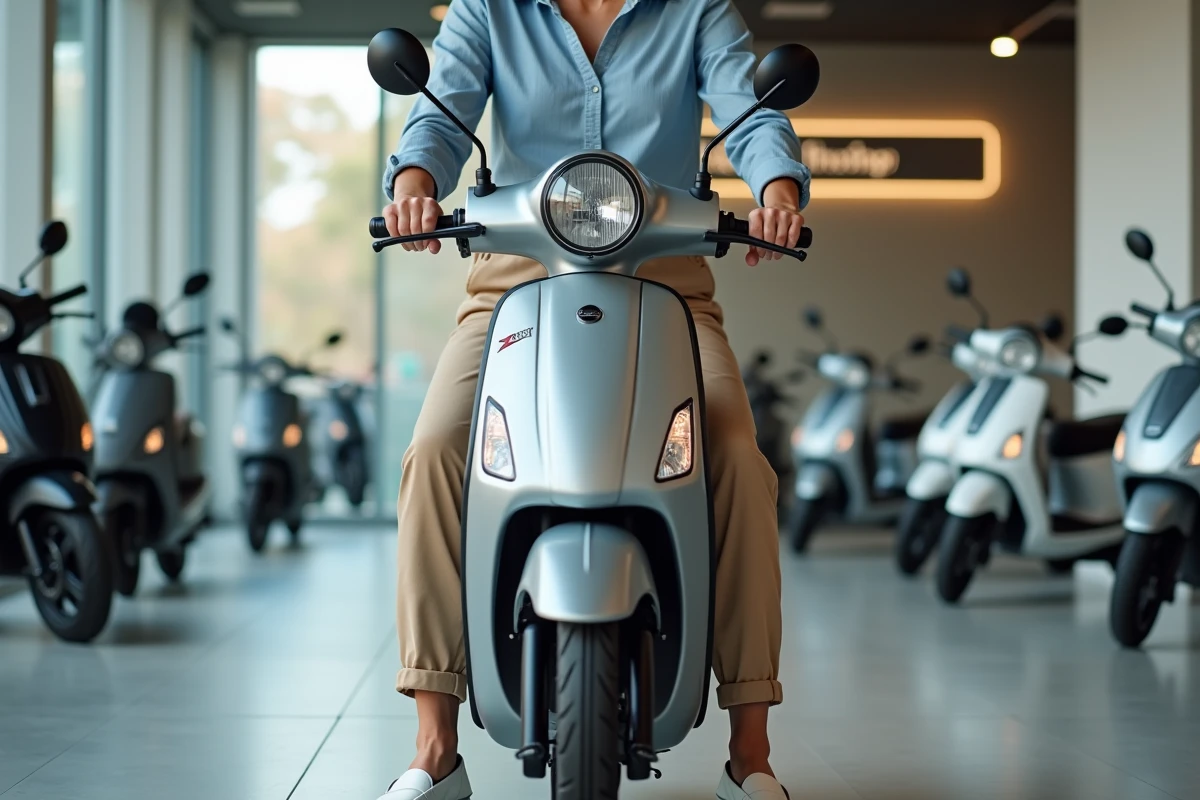
Length and width of an adult scooter: the dimensional ranges to remember
The technical sheets of recent urban scooters, both thermal and electric, reveal a convergence of formats. The length generally ranges between 1,650 and 1,900 mm, while the width is around 600 to 800 mm. A compact model like the e-Bonsaï measures about 1,660 mm long and 600 mm wide. A larger electric adult scooter reaches 1,870 mm in length and 810 mm in width.
These differences of a few centimeters have concrete consequences:
- A scooter shorter than 1,700 mm can weave more easily between lanes, but offers a smaller floor area to place feet flat while riding.
- Beyond 1,800 mm, the under-seat storage gains volume, and the passenger seat becomes genuinely usable on a daily basis.
- A width greater than 750 mm limits access to certain two-wheeler parking spaces in city centers, especially in Paris.
The length of the scooter determines both comfort and urban maneuverability. The choice is therefore made based on the type of trips: short home-work commutes or mixed city-periphery use.
Euro 5+ standards and dimension evolution in 50 cc scooters
The implementation of Euro 5 and then Euro 5+ for 50 cc scooters (generalization in 2024-2025) has caused a subtle but measurable change in dimensions. To comply with new emission and noise constraints, manufacturers have revised engine architecture, freeing up space in the frame.
Several manufacturers took the opportunity to extend the wheelbase and raise the seat compared to Euro 4 generations. The goal: to improve stability and ergonomics for larger sizes, often neglected in 50 cc scooters historically designed for a teenage audience.
This dimensional repositioning explains why some recent 50 cc scooters rival the comfort of 125 cc models from ten years ago. A well-sized Euro 5+ 50 cc scooter is suitable for an adult for short urban trips. Engine displacement no longer solely dictates the vehicle’s size.
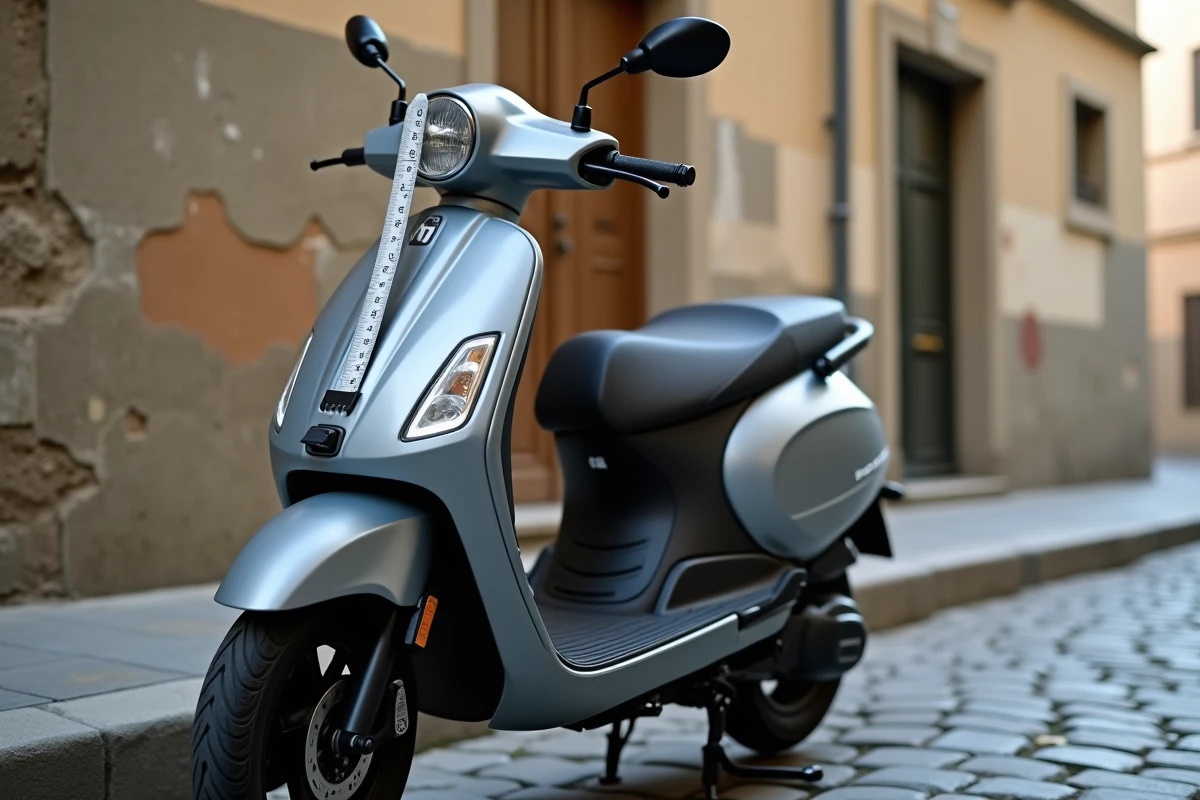
Thermal or electric scooter: do dimensions change according to the engine type?
At equivalent displacement (or equivalent power for electric), the external dimensions remain comparable. An electric scooter equivalent to 50 cc has dimensions similar to a thermal scooter of the same category. The difference lies elsewhere.
On an electric model, the battery adds weight to the floor and lowers the center of gravity. The scooter appears more stable at low speeds, but its total weight often exceeds that of an equivalent thermal model. This extra weight alters the feeling of maneuverability during U-turns and parking maneuvers.
The engine placement also varies: integrated into the rear wheel or housed in the frame with belt transmission. An engine in the wheel eliminates the belt and frees up space under the seat, allowing for a larger storage compartment without extending the vehicle. A central engine offers better mass distribution, useful for peri-urban trips at higher speeds.
What the technical sheet doesn’t always reveal
The handlebar width, rarely indicated on commercial sheets, often exceeds the width at the fairing by 50 to 100 mm. Checking this measurement avoids unpleasant surprises when trying to squeeze between two vehicles. The handlebar width is the true functional width of the scooter.
The steering angle, in turn, determines the turning radius. A long wheelbase combined with a small steering angle makes maneuvers difficult in an underground parking lot. These two data points rarely appear in buying guides but can be verified in just a few minutes during a test ride.
Choosing an adult scooter boils down to a question of compatibility between the vehicle’s dimensions and the rider’s physique. Rather than relying solely on engine displacement or price, measuring one’s inseam and comparing it to the seat height remains the most reliable action before any purchase.