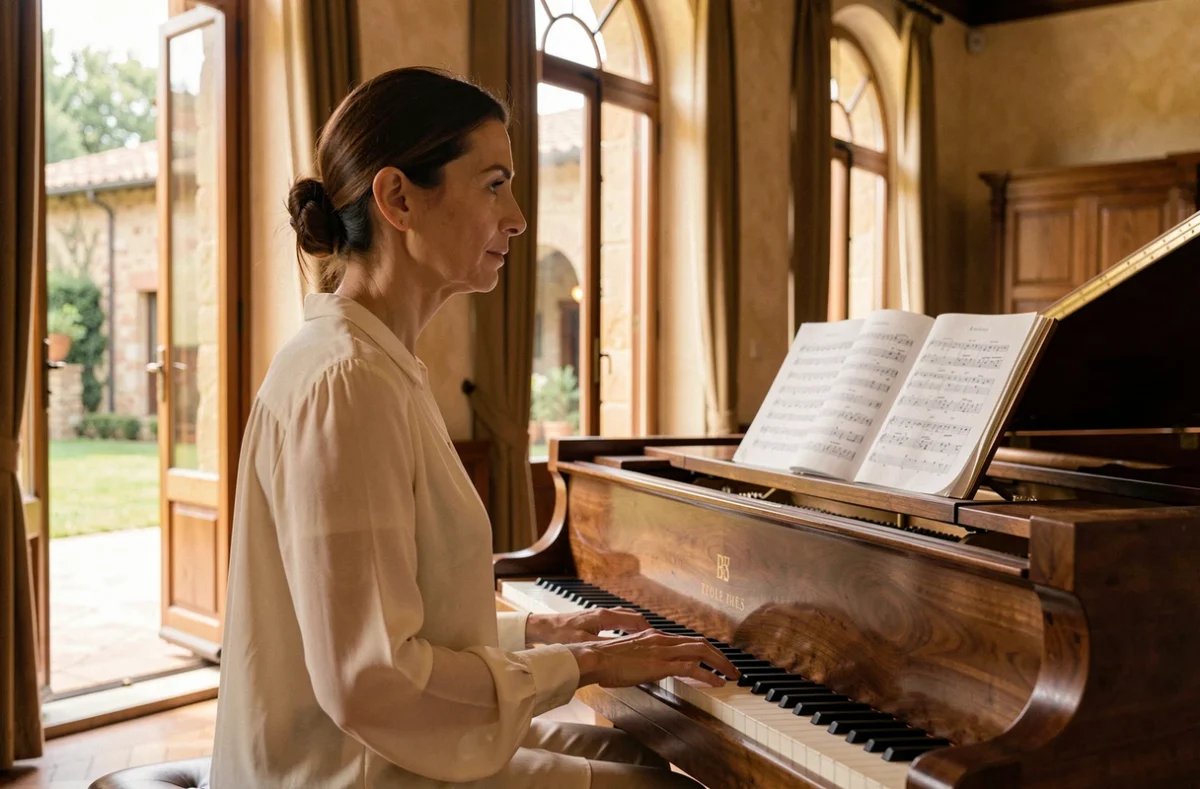
Enrica Cenzatti was born in Pisa, Tuscany. Her exact date of birth has not been made public, which immediately reflects her relationship with fame: none at all. Married to tenor Andrea Bocelli from 1992 to 2002 and the mother of two sons, she has never given an interview or made a public statement. Her life story must therefore be pieced together from indirect sources, primarily Bocelli’s own remarks and, later, those of their sons.
Meeting in Pisa and Andrea Bocelli’s musical life before fame
At the time, Bocelli was neither a renowned tenor nor a recording artist under contract. He performed regularly in bars and small venues across Tuscany.
The story of Enrica Cenzatti, Andrea Bocelli’s first wife, belongs to this pre-media era. She knew a local musician, not an international star. This gap between their married life and his career breakthrough is key to understanding what followed.
Their marriage came before the release of the album Romanza and the worldwide fame that followed. By the time Bocelli had become one of the world’s best-selling tenors, the couple already had two sons, Amos and Matteo, born during the singer’s commercial rise.
The Bocelli-Cenzatti separation: what the sources tell us
Their divorce was finalized in 2002, after ten years of marriage. The publicly cited reasons amount to the standard phrase irreconcilable differences. Enrica Cenzatti has never made a direct statement on the subject.
Bocelli later rebuilt his life with Veronica Berti, with whom he had a daughter before they married. The transition between the two relationships took place without a prolonged period of media speculation, at least on Bocelli’s side.
As for Cenzatti, she has remained completely silent. She has made no public comment on his remarriage and has not appeared in the Italian celebrity press. This consistent withdrawal is notable in the Italian media landscape, where the former spouses of celebrities are regularly approached for comment.
Child custody and life in Pisa
Enrica Cenzatti stayed in Pisa after the divorce. The two boys grew up mainly with her, in a Tuscan setting far removed from their father’s international circuit. No public custody battle has been documented, unlike other highly publicized breakups in the worlds of classical and crossover music.
Amos and Matteo Bocelli: two paths that shed light on the family legacy
Enrica Cenzatti and Andrea Bocelli’s sons have taken different paths, and it is through them that the public gets the few glimpses of the family dynamic.
- Amos Bocelli occasionally accompanies his father on piano at concerts, but his main career lies outside the music world.
- Matteo Bocelli chose an artistic path. He recorded the duet Fall on Me with his father, which achieved notable commercial success. His media presence continues to grow.
- Virginia Bocelli, born to Veronica Berti and Andrea Bocelli, completes the blended family. In a 2014 interview with The Guardian, Bocelli said that Berti had a good relationship with Enrica and that the family got together for birthdays.
This last detail comes from Bocelli, not Enrica. The distinction matters: everything the public knows about their co-parenting comes through the tenor or his sons, never directly from Cenzatti.
Enrica Cenzatti today: staying out of the spotlight and living privately in Pisa
Enrica Cenzatti has no public social media accounts. She does not appear at social events, galas, or ceremonies connected to her ex-husband’s career. The few biographical profiles that mention her generally describe her as a “housewife,” though it is impossible to verify whether she has a low-profile professional life.
Her indirect visibility increases as Matteo makes headlines, with his music career drawing attention to the Bocelli family as a whole. Online searches for Enrica Cenzatti spike whenever her sons appear in the media or Andrea Bocelli performs an anniversary concert.
Why Enrica Cenzatti’s discretion is so intriguing
In a world where even the slightest connection to a celebrity can be monetized through exclusive interviews, books, and documentaries, choosing to say nothing for decades is unusual. Enrica Cenzatti has never capitalized on her status as an ex-wife or tried to correct or qualify the public narrative.
This silence has a paradoxical effect: it fuels curiosity while leaving it unsatisfied. Articles about her recycle the same facts (Pisa, 1992, two sons, divorce in 2002) because there is simply no other source material.
Enrica Cenzatti’s story remains defined by a decade-long marriage to one of the most famous artists in contemporary classical music, followed by a complete retreat from public life. The public narrative depends entirely on third-party sources. Her sons are the only visible link between her and the media, and probably the only form of visibility she has not tried to avoid.