
The connected navigation in Ford relies on the SYNC system, which has evolved through several generations. Each version includes distinct features, and the differences between SYNC 3 and SYNC 4 go beyond just the graphical interface. What concrete differences separate these two generations in terms of navigation, connectivity, and offline coverage?
SYNC 3 and SYNC 4: Comparative Table of Ford Navigation Functions
The transition from SYNC 3 to SYNC 4 has changed how Ford manages embedded navigation. Here are the main differences on the points that matter in daily use.
| Criteria | SYNC 3 | SYNC 4 |
|---|---|---|
| Integrated connected navigation | Optional depending on trim | Integrated in most models |
| Offline maps | Not available | Available without cellular network |
| Map updates | Via USB or dealer | Over-the-air (OTA) |
| Apple CarPlay / Android Auto compatibility | Yes (wired) | Yes (wireless on certain versions) |
| Touchscreen | 8 inches max | Up to 15.5 inches depending on model |
| Real-time points of interest search | Limited | Connected with live traffic |
The most tangible gain concerns offline navigation with maps accessible without a network. Ford positions this feature as a response to white zones, which are common on rural or mountainous routes in France.
To learn everything about Ford connected navigation, the distinction between these two generations remains the logical starting point before choosing a vehicle or planning an update.

Ford Offline Navigation: An Argument That Goes Beyond Comfort
Ford has strongly emphasized offline navigation in its recent communications. Maps remain accessible even without cellular coverage, which changes the game for drivers who frequently travel off the main roads.
This approach addresses a common frustration: the loss of GPS guidance in rural or mountainous areas, precisely where a reliable route is most useful. On SYNC 3, the only workaround was to switch to a smartphone via CarPlay or Android Auto, with the battery and data plan limitations that this entails.
Why Offline Coverage Matters So Much
A trip in Lozère, in the Cévennes, or in certain Alpine valleys quickly exposes the limits of 100% connected navigation. The embedded mapping of SYNC 4 works without a signal, eliminating this dependency.
For converted and utility vehicles, this function makes even more sense. Converters like A.C.A France integrate Ford connected navigation into their leisure vehicles, such as the Ford Custom Liberty, where it accompanies the adaptive cruise control and onboard living equipment. The deployment of Ford connected navigation goes beyond sedans and SUVs to cover uses in touring and long-distance travel.
Subscription and Map Updates on SYNC 4
The commercial logic surrounding Ford navigation has evolved. Older generations often included navigation without a clear distinction between what was part of the vehicle purchase and what required renewal. With SYNC 4, Ford structures its offering more around a subscription model for connected services.
Map updates are now done via OTA (over-the-air), without needing to visit a dealership or manipulate a USB key. This system ensures up-to-date maps but assumes that the vehicle has an active connection.
- Connected navigation services (real-time traffic, points of interest search) require an active subscription after the trial period included with the purchase
- Offline mapping remains accessible even without an active subscription, as the maps are stored locally
- OTA updates cover both system patches and new road data
This distinction between paid connected functions and free local mapping should be verified at the time of purchase. The exact content of the subscription varies by market and model.
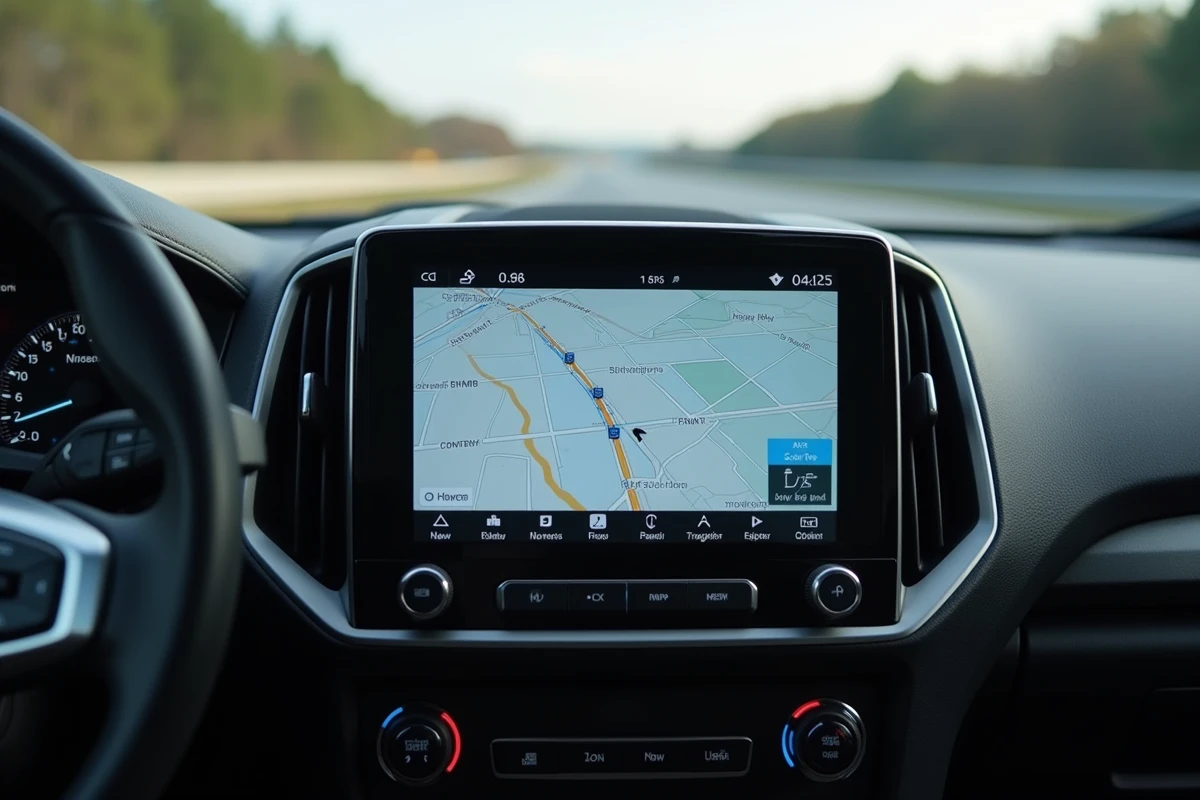
Apple CarPlay, Android Auto, and FordPass: What Role Do They Play Against Integrated Navigation?
Many Ford drivers use Apple CarPlay or Android Auto to access Waze or Google Maps, even in vehicles equipped with native navigation. This trend is particularly pronounced in models with SYNC 3, where the integrated navigation remains less fluid than third-party applications.
On SYNC 4, the gap narrows. The native interface becomes more responsive, and the wireless compatibility with CarPlay and Android Auto eliminates the cable. The choice between Ford navigation and third-party applications then depends on specific criteria.
What Favors Native Ford Navigation
- Guaranteed operation without a smartphone, without mobile data, and without phone battery
- Direct integration with the vehicle’s instrument cluster (head-up display on certain models)
- Access to consumption and range data for electric or hybrid vehicles via the embedded system
What Pushes Towards CarPlay or Android Auto
The richness of the application ecosystem remains the main advantage. Waze, with its community alerts, or Google Maps, with its database of businesses, often offer a denser coverage of points of interest. The FordPass app complements the system by allowing users to locate the vehicle, check the charge status, or plan a trip from home before getting in the car.
However, simultaneous use of CarPlay and native Ford navigation is not always possible: one takes precedence over the other depending on the configuration. Checking this point during the vehicle test avoids unpleasant surprises.
The choice between integrated navigation and third-party applications is not binary. On SYNC 4, both coexist better than before, and offline mapping gives a concrete advantage to the Ford solution in situations where the smartphone reaches its limits.