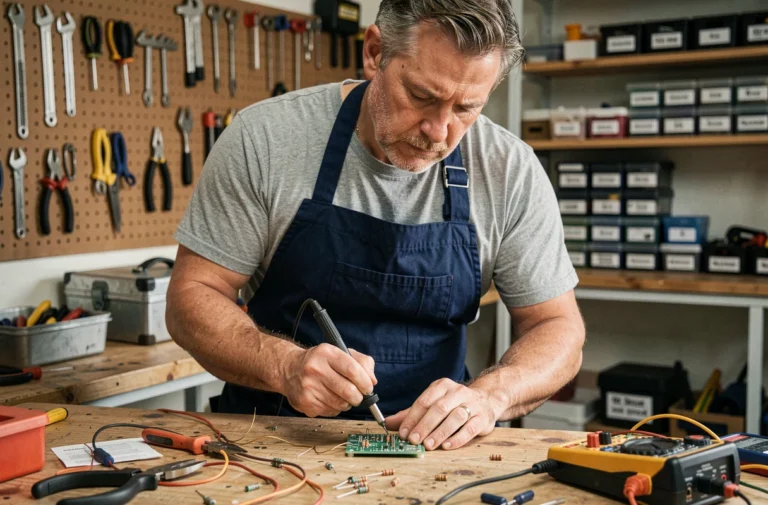
The race to buy this year’s connected gadgets and geeky products masks a blind spot: how long these devices actually last. With spare parts nowhere to be found, software updates discontinued and batteries glued in place, the most appealing high-tech product on paper can become an expensive paperweight after just a few seasons. Here are the geek and high-tech trends that deserve technical scrutiny, not just hype.
Repairability of connected devices: the real geek criterion in 2026
A gadget that can’t be repaired isn’t a good gadget. European discussions about extending repairability requirements to new product categories cover access to spare parts, repair information, software and firmware, as well as disassembly and reassembly.
The issue goes beyond screws. With Bluetooth headphones, a smart speaker or a fitness tracker, repair can be blocked by a software lock before anyone even gets to the hardware. The European consultation explicitly includes this dimension: a device may be irreparable because its firmware is locked, not just because a part is missing.
These are still proposals under consultation, not requirements currently in force. The approach is cross-cutting, with common requirements for several product families rather than rules for each product individually. For tech enthusiasts, this means that evaluating a product in 2026 requires checking the manufacturer’s update policy as well as the spec sheet.
Specialist media are keeping a close eye on all these developments. Articles published on https://www.geekstinct.fr regularly cover these topics, combining regulatory news with product reviews.

European repair directive: which geek devices are actually covered
The European repair directive does not apply uniformly to all devices. The 2026 analysis reveals a significant gap: phones and tablets are covered, but laptops and desktop computers are not. For geek audiences investing in PC builds, gaming laptops or workstations, this exclusion changes the equation.
In practical terms, a smartphone bought in 2026 will benefit from stronger requirements for parts availability and access to repair guides. A laptop from the same generation will not. This imbalance makes it worth prioritizing manufacturers that voluntarily adopt open standards across their computer ranges.
What to check before buying a high-tech device
- The guaranteed period of operating system and firmware updates, which determines how long the device remains functional—well beyond its hardware warranty
- Whether spare parts (battery, screen, connectors) are expected to remain available, and whether public disassembly manuals exist, regardless of whether the manufacturer is covered by the directive
- How the battery is secured (glued, screwed in or soldered), which determines whether an independent repairer can replace it or whether the device must go to an authorized service center
AI regulation and transparency: what this means for consumer products
European AI regulation is being introduced in stages, with transparency requirements scheduled to take effect during 2026. These directly affect AI features built into consumer products and services, including voice assistants, personalized recommendations, photo filters and content-generation tools built into smartphones or smart speakers.
For geek-minded consumers, the key question is when a product uses an AI model and what that model does with their data. Transparency requirements oblige providers of high-risk AI systems and certain general-purpose systems to document and disclose these uses. We’re seeing manufacturers that are getting ahead of the rules already adding indicators to their interfaces.
On-device AI and local AI: two approaches to distinguish
The rise of local AI, which runs directly on a device without connecting to the cloud, changes the equation. Photo processing on a recent smartphone can run entirely on-device, reducing exposure of personal data. By contrast, a connected voice assistant relies on remote processing, and transparency varies by provider.
A geeky device with local AI will last longer than one that depends on a cloud service its provider can discontinue. That’s a practical factor to consider, just like processor speed or battery life.

Geeky high-tech trends: product categories to watch this year
Beyond the splashy announcements, three product categories are seeing the most tangible changes this year.
Bluetooth speakers and connected audio devices are increasingly adding AI features, such as adaptive equalization and context-aware noise reduction. Their value depends on the quality of their on-device processing and the manufacturer’s update policy. A model whose firmware is no longer maintained after two years loses some of its functionality.
Connected home devices (thermostats, lighting and locks) are becoming more interoperable thanks to the Matter protocol, which reduces reliance on a single ecosystem. We recommend checking for Matter compatibility before buying, as it determines whether you can switch platforms without replacing the hardware.
Mid-range smartphones are catching up with flagship models in photography and battery life, making value for money over the long term more relevant than upfront value for money. A phone covered by the European repair directive, with a replaceable battery and updates guaranteed for several years, will remain functional far longer than a flagship whose support ends after three years.
Choosing a geeky or high-tech product this year means weighing today’s spec sheet against the device’s ability to remain useful over time. Hardware repairability, software maintenance and transparency around built-in AI are no longer niche concerns: they’re the three filters that distinguish a considered purchase from a disposable one.