A classic car that sleeps in a garage eventually deteriorates. The seals dry out, the paint chips, and the engine seizes. For an old vehicle to keep running, it needs parts, know-how, and enthusiasts capable of passing on their skills. Automotive associations have played this role for decades, organizing collective life around rolling heritage.
Analog Mechanics and Electric Transition: The Skills Challenge Clubs Must Face
You may have noticed that a young mechanic trained on recent vehicles doesn’t always know how to adjust a float carburetor? This gap highlights a concrete problem. Professional training programs now focus on electric motors and embedded electronic systems.
The skills related to analog mechanics, such as adjusting a points ignition or timing a distribution without a sensor, are becoming rare in traditional workshops. Associations of vintage vehicles are often the last places where these techniques are still regularly practiced.
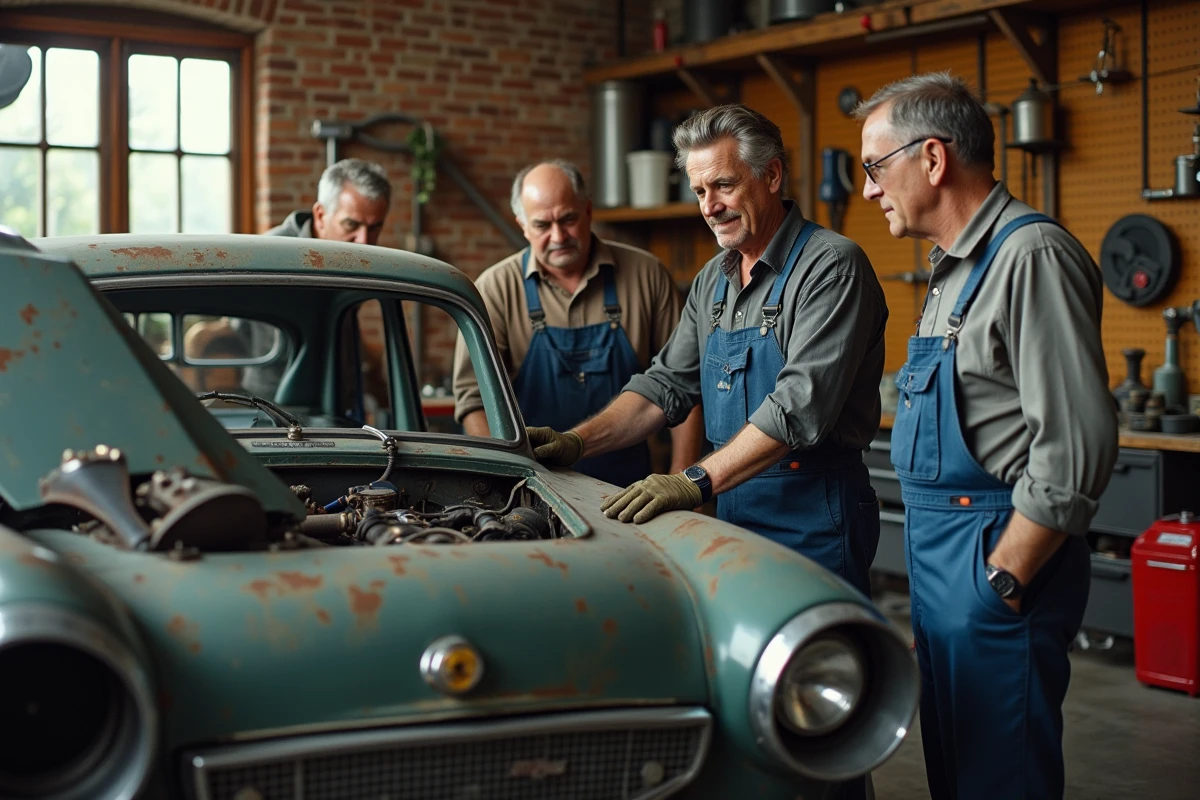
Some clubs organize intergenerational workshops: a retiree who spent his career on carbureted engines mentors an apprentice during a weekend restoration. This type of direct transmission partially compensates for the decline of official training. The Compagnons du Devoir, for example, showcased a body restoration project led by their learners at the Rétromobile 2026 show, a sign that the automotive arts sector is seeking new pathways.
However, few associations have formalized a real structured educational program. Most operate on volunteer work and word of mouth. The medium-term risk is to see skills disappear due to a lack of documentation and reproducible pathways. Several online resources are attempting to unite these initiatives, as can be seen on https://www.wdcar.org/, which lists information related to the associative automotive world.
Mutual Aid Network for Spare Parts: What Associations Are Changing on the Ground
Restoring an old model without access to original parts can sometimes be a puzzle. Manufacturer catalogs have disappeared, suppliers no longer produce certain references, and stocks of new old stock parts are dwindling.
Associations reduce maintenance costs through exchange networks among members. This mechanism works simply: a member who dismantles a donor vehicle offers their surplus parts to the club. Another member is specifically looking for that carburetor or wiring harness. The transaction is made at a reduced price, sometimes through barter.
In rural areas, this system becomes even more valuable. Specialized workshops are rare, and shipping costs for ordering remotely can be heavy. Feedback from Vendée shows that local clubs allow their members to keep their vehicles operational at a significantly lower cost than the conventional market.
- Swap meets organized during gatherings allow for finding parts that are unavailable online, often at negotiated prices among enthusiasts.
- Internal discussion groups within clubs send alerts when a member spots a batch of parts from a private individual or a liquidating garage.
- Some associations maintain a shared inventory of parts available from their members, which can be consulted before each meeting.
European Twinning Between Car Clubs: An Underutilized Lever
In recent years, French associations have been developing partnerships with Italian and German clubs. These twinnings facilitate the exchange of restoration techniques and allow for vehicle loans for cross-border exhibitions.
Why does this type of cooperation matter? Because each country has developed different restoration specialties. Italian clubs often excel in artisanal upholstery for Alfa Romeo or Lancia models. Germans have networks of specialized suppliers for post-war Mercedes or Porsche mechanics. The French, on the other hand, maintain a recognized expertise in bodywork and painting.
However, these exchanges remain limited to a few pioneering clubs. The majority of local associations lack the contacts and logistical means to organize international meetings. A more structured federal framework could accelerate these twinnings, connecting clubs by mechanical specialty rather than just geographical proximity.
Gatherings and Collectors: Beyond Nostalgia, A Vibrant Market
Gatherings of vintage vehicles attract a much wider audience than just collectors. Families, curious onlookers, photographers, or industrial design enthusiasts gather around models they may have never seen in motion.
For clubs, these events serve multiple functions:
- They provide visibility to associations and attract new members, renewing the pool of volunteers and skills.
- They create an informal market where vehicles, parts, and restoration services are negotiated between individuals.
- They serve as a showcase to local elected officials, facilitating support for organizing future events.
The FFVE, recognized as a public utility, federates over 1,250 clubs, associations, and museums in France. This territorial network allows for organizing events in municipalities of all sizes, not just in major metropolitan areas. A well-organized local gathering can become a structuring annual event for a small town.
Authenticity of Models and Collection Criteria
The question of authenticity consistently arises in discussions among collectors. Should a vehicle be preserved in its original state, even if degraded, or restored with new parts reproduced identically? Associations play an informal arbitrator role on this subject, disseminating technical references and training the eye of enthusiasts.
A vehicle restored with compliant parts retains its value better in the market than a modified model with anachronistic elements. Clubs that document their restorations, supported by photos and technical sheets, help establish quality standards recognized by both buyers and specialized insurers.
Automotive heritage is not preserved in a museum behind glass. It runs, it breaks down, it gets repaired. Associations remain the link that connects old skills to today’s enthusiasts, provided they formalize their transmission more and open up to collaborations that go beyond their usual scope.